
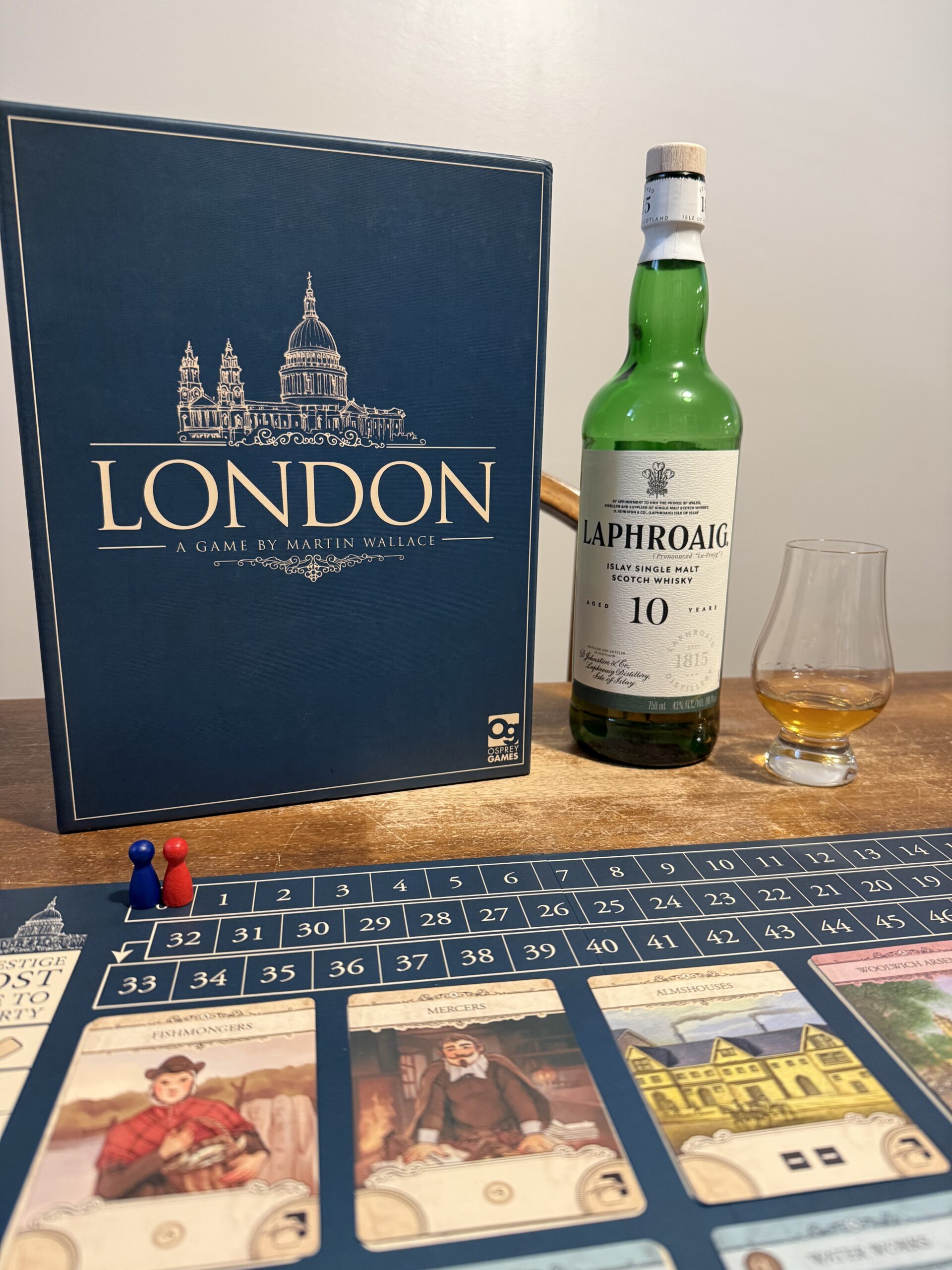


Welcome back to Dice & Drams!
This month’s pairing is for my classy readers out there. If you enjoy fancy steakhouses, leather couches, and Cuban cigars, you’ll appreciate what I have for you. Of course, we don’t discriminate – if you’re a person with no class, such as fans of the Denver Broncos (I kid…), you’re welcome to read on and get a little fancy with us. Enjoy!
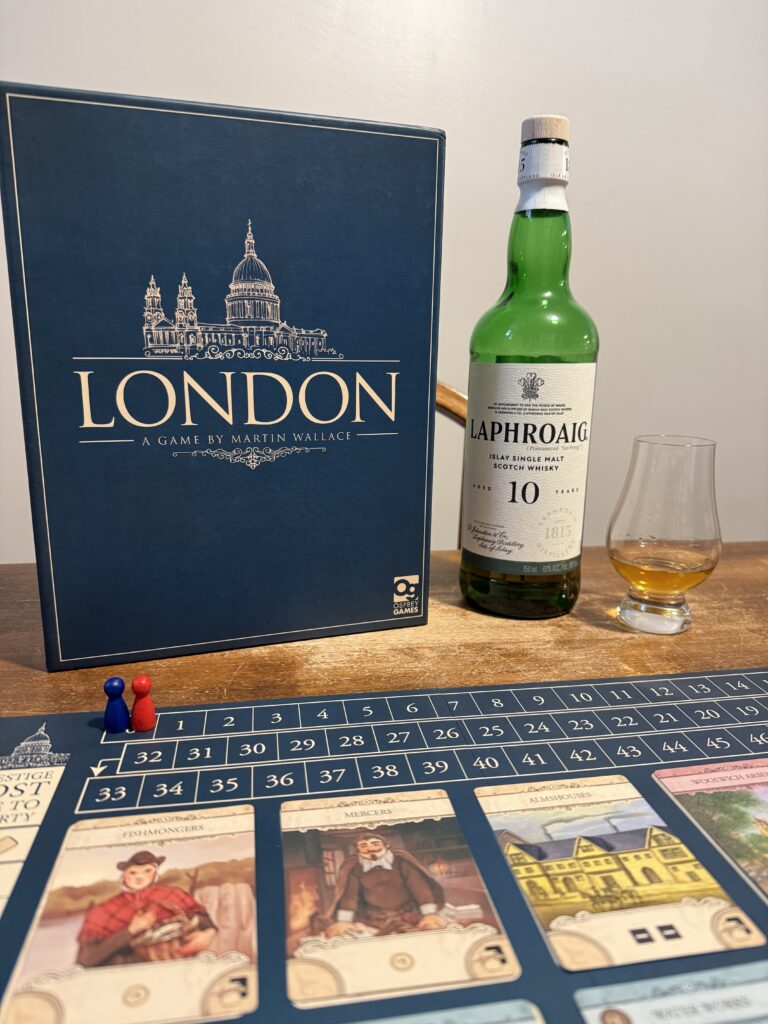
The Pairing: Laphroaig 10 with London
The Whisky: Laphroaig 10
One of the crown jewels of the Islay region, Laphroaig single malt Scotch whisky is known for one thing: peat. Every Laphroaig release has some level of peat in it, ranging from mild to drinking smoke. Obviously not everyone’s thing, but for those who appreciate the Islay style you can’t do much better. This is Laphroaig’s base offering – I’m excited to explore their higher releases, but will start with this one.
On the nose, the peat makes itself known immediately. Notes of campfire smoke, salty crisp bacon and seaweed all together create a beautiful salty symphony. I wouldn’t call this level of peat overwhelming at all though – it’s certainly the central presence, but there’s some nice sweetness there too that really balances the profile out. Vanilla floats around, and a caramel note that, with the more savory notes, manifests as salted caramel rather than Werther’s. I also smell a fruity note that reminds me a raisins, which is a nice touch.
The palate is defined by that peat for sure, but again, there’s some really nice sweetness there as well. Seaweed is prominent, along with that salted bacon. A new salty note emerges too: pickle brine, which may sound weird but is really tasty. The salted caramel is definitely present in there, along with chocolate covered pretzels, creating a beautiful symphony of salty-sweetness on my tongue.
Finally, the finish lasts an incredibly long time and is defined by the peat once again. That smokey note from the nose returns, swimming along with pickle brine and bacon. That salty mix stays in your palate for what feels like minutes, allowing you to really appreciate the depth of flavors there.
The Game: London
London is the second game by Martin Wallace to be featured in Dice and Drams, which is a little shameful because of how much I like his designs. Wallace’s masterpiece will always be Brass, but he has plenty of other excellent designs too. Counted among them is London, an older engine-building card game originally released in 2010. I have the re-release from 2017, which has slightly different rules but is the same core game.
In London, players take the role of architects in London rebuilding the city after the Great Fire in 1666. While we’re all trying to accomplish the same task, the goal is to do so the most efficiently, and to be ultimately recognized as the best architect. Players accomplish this by purchasing cards from a shared market. These cards represent buildings and people in the city, and are the ultimate source of points for the players. Players then have other actions to choose from – playing cards down into their tableau, purchasing landmarks, or running their engine. The most important of these actions is running their engine – this means taking a turn to activate the abilities of the cards laid out before them. This will gain the player money, points, and other positives, but it will also generate poverty – the other currency of the game. It’s impossible to build a city without poverty, and the poverty mechanic in London represents that. As players participate in building London, they gain poverty markers. The more poverty markers one has at the end of the game, the more points they lose. So, you can’t just go all-in on creating a huge tableau and running it over and over, as you’ll end up losing a ton of points at the end of the game. Players need to invest in social programs and careful, slow growth in order to succeed.
There’s also a debt mechanic in the game, which no Wallace design would be complete without. Even if players don’t have the cash to purchase a card or landmark, they can always go into debt for it. This adds flexibility, but debt is also expensive and is punishing at the end of the game, like poverty. Don’t make this decision lightly!
I enjoy London for a couple of reasons. First, it’s an elegant design that doesn’t puff itself up with unnecessary pieces or a heavy ruleset – it can be learned in ten minutes, which is nice for a game of this genre and weight. Second, it’s a game that feels good to have on the table because of its visual design. The cover is simple and beautiful, and the card art has a nostalgic feel to it that I really appreciate. Overall, a winning experience.
The Final Pairing:
This pairing has less to do with the notes in the whiskey or the design of the game and more to do with what you exude while drinking Laphroaig or playing London – class. It’s easy to be classy drinking an old wine vintage or staying in a five-star hotel. It’s a little less easy to look classy playing a board game, but London pulls it off. The beautiful, nostalgic art and elegant cover, along with the visual of seeing a city tableau build up over time, make for a scene James Bond would strive for (an exaggeration you say? Maybe…). Laphroaig, on the other hand, is no doubt a classy pour. Islay rivals Highland for the most iconic Scotch region, and sitting back and sipping a Laphroaig is one of the more stylish experiences you can have, in my opinion. So, sit back, pour some Laphroaig, start building London, and enjoy how sophisticated you are.
Cheers and happy gaming!

