
The Historic Accord That Nearly Failed
“Quiet, please.”
The professor placed his notes on the lectern, removed his glasses and surveyed the classroom.
“I said quiet.”
The conversations faded. Chairs scraped against the floor as the students turned toward the front.
“Thank you. Open your texts to Chapter Seventeen.”
He turned to the blackboard and wrote:
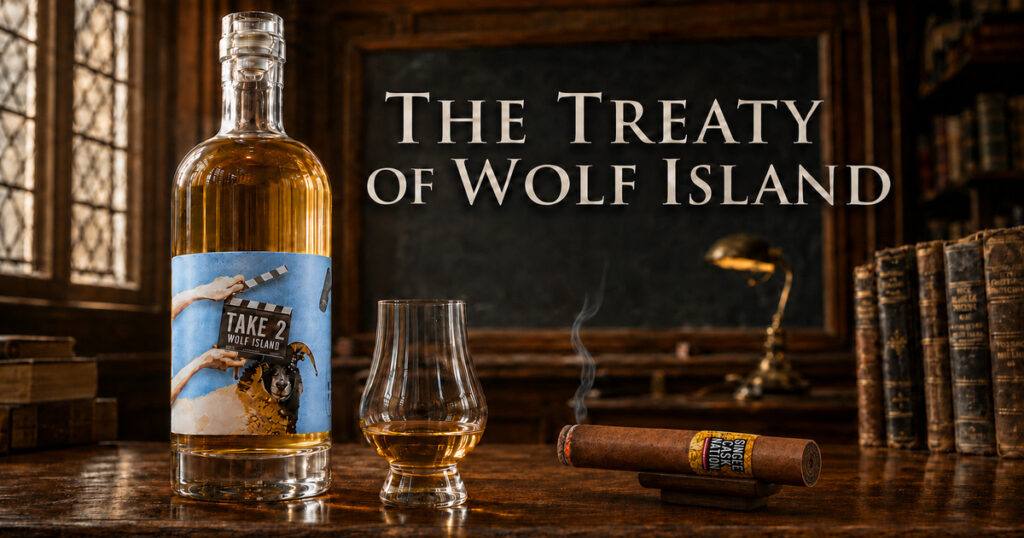
THE TREATY OF WOLF ISLAND
“Today, we examine one of the most misunderstood diplomatic agreements in modern history. Contrary to what several of you wrote on your examinations, the Treaty of Wolf Island was not inevitable simply because the participants shared a name.
“It was a difficult negotiation involving representatives from Scotland, Nicaragua and Texas. The opening session was so unpleasant that many observers believed the summit should be abandoned.
“Yet the talks survived, an accord was eventually reached, and history remembers the treaty today—not because it began well, but because it succeeded at all.”
The Scottish Delegation
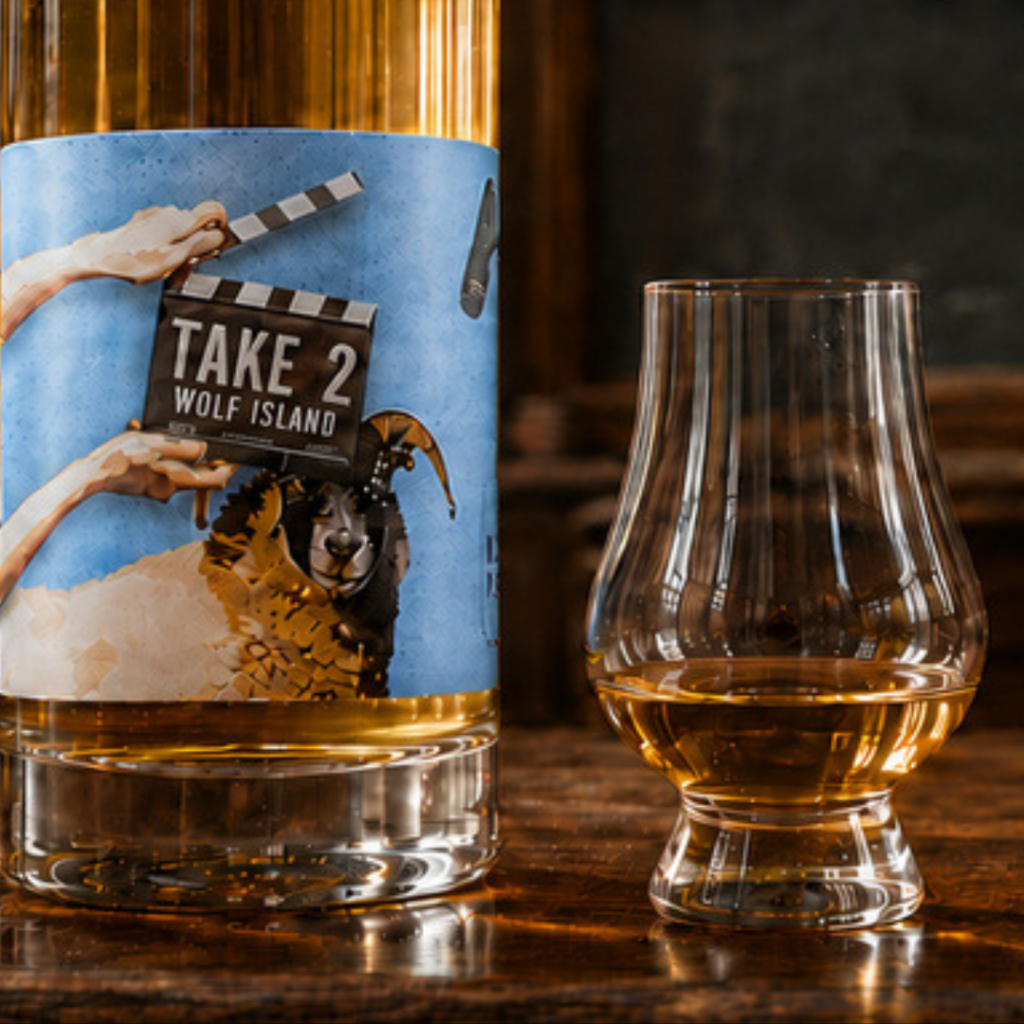
Representing Scotland was Single Cask Nation’s WOLF Island Take 2; a Single Malt Scotch Whisky created in collaboration with The Water of Life film.
Although its distillery remains undisclosed, its Island origins are acknowledged. The whisky was assembled from six first-fill ex-bourbon casks—five unpeated and one lightly peated—and bottled at 48.8 percent alcohol by volume.
The Scottish delegation arrived with considerable presence. It’s citrus and sweetness led the profile, followed by an abundance of stone fruit. Apples, peaches and pears filled the palate, making the whisky a genuine fruit bomb rather than one offering only a passing suggestion of orchard character. A small pepper bite gave the fruit definition, while the mouthfeel was rich, rounded and especially impressive. Smoke remained present throughout, but it was not medicinal, maritime or overly aggressive. It was warmer and earthier, closer to the steady glow of a campfire. It never shouted, yet it never left the room. The finish was decently long, though not astonishingly so, bringing hazelnut toffee, coffee and lingering sweetness.
The whisky was very good on its own. It required no alliance to justify its place at the table.
The Nicaraguan Delegation
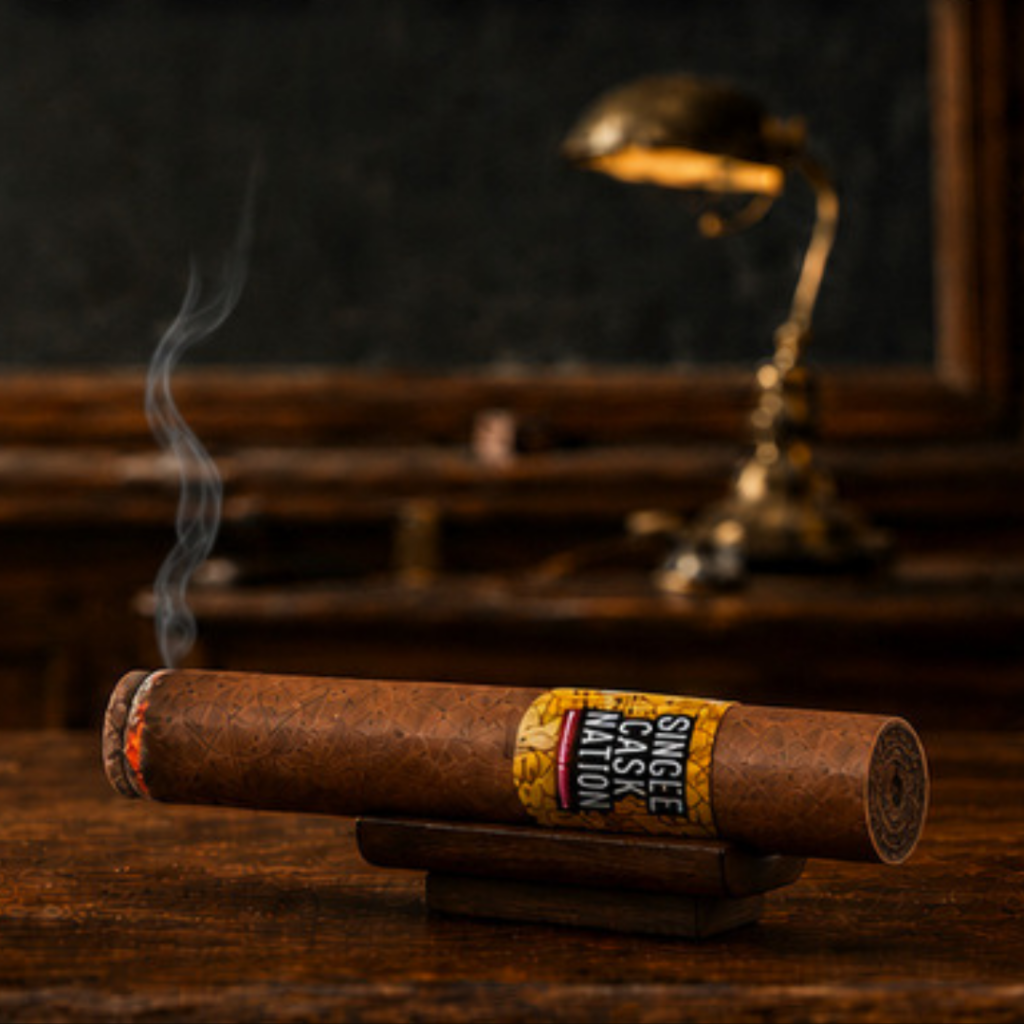
Across from the whisky sat the 2026 Single Cask Nation cigar, sold exclusively through 2GuysCigars and produced in partnership with Aganorsa Leaf.
This was the fourth release in the collaboration, following earlier editions in 2019, 2021 and 2023. The 5.25-by-50 cigar employed Aganorsa’s Nicaraguan Corojo 99 and Criollo 98 tobaccos.
On its own, the cigar offered cedar, earth and pepper, supported by natural sweetness. Charred oak and faint peat appeared behind the tobacco smoke, reflecting the influence of an ex-peated whisky barrel from Balcones Distillery. Of all its flavors, the sweetness and cedar remained the most persistent.
Like the whisky, the cigar stood perfectly well independently.
The professor looked up from his notes.
“This,” he said, “is where inexperienced historians make their first mistake. Two parties may be excellent alone and still prove disastrous when seated together.”
The Texas Intermediary
Between the Scottish and Nicaraguan delegations sat the ex-peated Balcones barrel.
Its role was to provide a common language.
The barrel had once held peated Texas single malt before lending some of its influence to the cigar. The cigar therefore arrived carrying charred oak and faint peat, while the whisky possessed its own steady campfire smoke.
On paper, the connection appeared obvious. Scotland brought malt, fruit and restrained peat. Nicaragua brought tobacco, earth, cedar and pepper. Texas stood between them, having carried whisky smoke into the cigar’s aging process. Yet an intermediary can arrange a meeting without guaranteeing agreement.
The barrel gave the parties something to discuss.
It could not make them cooperate.
The Opening Negotiations
The first session began with optimism.
Both representatives bore the Single Cask Nation name. Both had connections to peated whisky. Both had performed admirably alone.
Then the cigar was lit.
The negotiations became unbearable.
The disagreement came almost entirely from the cigar’s side of the table. During the first third, the combination became harshly discordant and far less pleasurable than either participant had been independently. This was not a brief adjustment between pepper and alcohol. The incompatibility persisted through the first third and threatened the entire summit.
The cigar’s cedar, earth, pepper and sweetness seemed unable to arrange themselves properly beside the whisky. Rather than joining the fruit, sweetness and campfire smoke in the glass, the cigar fought against them.
At first, the individual cigar was blamed. Perhaps the selected representative was defective or improperly stored, so a second cigar was summoned.
It produced almost precisely the same result.
The professor walked to the blackboard and underlined the words TWO CIGARS.
“One poor opening,” he said, “may be dismissed as an anomaly. Two substantially identical experiences establish a pattern.”
Thus, began what historians now call the Wolf Island Crisis.
The Wolf Island Crisis
The whisky saved the negotiations.
It did not transform the first third into a good pairing. The opening remained deeply unpleasant. It simply contributed enough pleasure to keep the experience from becoming completely irredeemable.
Its citrus and sweetness provided relief. Apples, peaches and pears continued arriving in abundance. Its mouthfeel remained rich, and its campfire smoke held steady. The whisky never became bitter, thin or confused beneath the cigar. It delivered from beginning to end. More remarkably, it did so without overpowering its counterpart.
At 48.8 percent alcohol by volume, WOLF possessed enough strength to bury the cigar beneath alcohol, fruit and smoke. Instead, it held its position and made the pairing remotely pleasurable without creating the illusion that harmony had been achieved.
This was not diplomacy at its finest. It was crisis management.
Many observers would have abandoned the summit during the first third, and few could have blamed them. Yet the talks continued.
Then the cigar began to change.
The Second Session
As the burn line entered the second third, the hostility receded.
The cigar finally began to come into its own. Its characteristics became better organized. Natural sweetness grew more apparent, cedar returned to the center of the profile, and the pepper no longer seemed determined to destroy the negotiations. Charred oak and faint peat also began communicating more effectively with the whisky’s campfire smoke.
For the first time, the Balcones intermediary appeared capable of performing its intended role.
The smoke in the whisky and the smoke in the cigar were still different. The whisky remained warm and earthy, while the cigar stayed rooted in Nicaraguan tobacco, cedar and spice. Yet the two forms of smoke no longer contradicted each other.
The whisky’s fruit and sweetness continued to lead. Apples, peaches and pears remained the loudest voices at the table, while the cigar answered with cedar and natural tobacco sweetness.
The pairing had not merely become tolerable. It had become genuinely enjoyable.
The Final Deliberations
By the final third, the agreement seemed almost impossible to reconcile with the disaster of the opening session.
WOLF Island Take 2 never let up. Its fruit remained expressive, its mouthfeel continued to impress, and its pepper, sweetness and campfire smoke held their positions. Hazelnut toffee and coffee provided darker notes beneath the orchard fruit.
The cigar had also fully emerged from its troubled beginning. Its cedar and sweetness remained the most memorable characteristics, supported by earth, pepper, charred oak and faint peat. Those darker flavors now complemented the whisky’s coffee, hazelnut and smoke.
The whisky remained the stronger participant, but strength should not be confused with aggression. It did not overpower the cigar.
The cigar’s tobacco character remained recognizable, and its cedar, sweetness and earth were never erased.
Nevertheless, the balance of power was clear.
The whisky won.
It had controlled the negotiations from the beginning, carried the pairing through its crisis and remained the most compelling element after the cigar recovered.
The cigar ultimately accepted a subordinate role—but an important and highly enjoyable one. Cedar and earth framed the fruit. Charred oak and faint peat broadened the campfire character. Natural tobacco sweetness connected with the whisky’s orchard fruit and toffee.
The whisky led.
The cigar followed.
Both remained present.
The Historical Verdict
The professor returned to the lectern.
“We must now answer the question that has divided scholars for generations,” he said. “Was the Treaty of Wolf Island a success?”
Those who believe a pairing should create immediate harmony may reject the treaty entirely. Their argument has merit. The opening was not merely imperfect. It was almost unbearable, and the result was repeated with two cigars. That cannot be ignored.
Others will judge the treaty by what it ultimately became. The second and final thirds were genuinely enjoyable. The whisky remained excellent throughout, and the cigar eventually found a role in which its cedar, sweetness, earth and barrel influence enhanced the experience.
The most accurate judgment lies somewhere between triumph and failure. The treaty was signed, but its terms were unequal.
The Scottish delegation emerged as the dominant power and principal architect of the agreement. The Nicaraguan delegation did not achieve parity, but after its disastrous opening, it became an outstanding supporting partner.
The Texas intermediary provided a connection through peat and barrel influence, although it could not prevent the initial crisis.
The professor closed his text.
“The Treaty of Wolf Island teaches us that two excellent products do not automatically create an excellent pairing. It also teaches us that first impressions, while important, do not always tell the entire story.”
He turned toward the blackboard.
“The whisky remained the star. Its citrus, sweetness, apples, peaches and pears never abandoned the proceedings. Its mouthfeel provided weight, its pepper provided structure, and its campfire smoke connected beautifully with hazelnut toffee and coffee.”
The cigar eventually found its place beside it. Cedar and natural sweetness became its most effective contributions, supported by earth, pepper, charred oak and faint peat.
The whisky did not overpower the cigar. It simply outperformed it.
By the second and final thirds, the cigar no longer impeded the whisky. It supported it, darkened it and helped transform an unlikely pairing into an enjoyable one.
The professor removed his glasses.
“That is why the Treaty of Wolf Island remains such a peculiar accord. It began with two accomplished parties behaving terribly together. It survived because the stronger participant refused either to collapse or to conquer. And it succeeded when the weaker partner finally began to contribute.”
The bell rang, and the students gathered their books.
“Your assignment for next week,” he called over the noise, “is to decide whether a treaty that fails for one-third of its existence can still be considered successful.”
A student near the door raised his hand. “Professor, what is the correct answer?”
The professor considered the question. “The correct answer,” he said, “is that the whisky won.”
He turned back toward the blackboard.
“But history would have been considerably less interesting without the cigar.”

