

I have had the great honor of visiting The GlenAllachie distillery in person and receiving a private tour on a Sunday, when it was normally closed, from the man himself: Billy Walker. I dare say that if you ever have the opportunity to walk through a distillery with its co-owner and Master Distiller, it is most definitely worth your time. You learn a great deal from the equipment, the warehouses, and the whisky, of course. But you learn even more from watching how the person responsible for it all sees the place.
Also, in the planning phases of a pairing, if Sam Filmus of Impex Beverages asks you to use The GlenAllachie 15-year-old in a cigar pairing, your ears should perk up immediately—especially if you are a devotee of GlenAllachie, as I am.
That experience at the distillery stayed with me as I considered Sam’s request. I spent a good bit of time deciding what should accompany what I consider the most well-rounded—and perhaps the most distinctly Billy Walker-esque whisky in GlenAllachie’s core range: The GlenAllachie 15.
What on earth could I put alongside such a whisky?
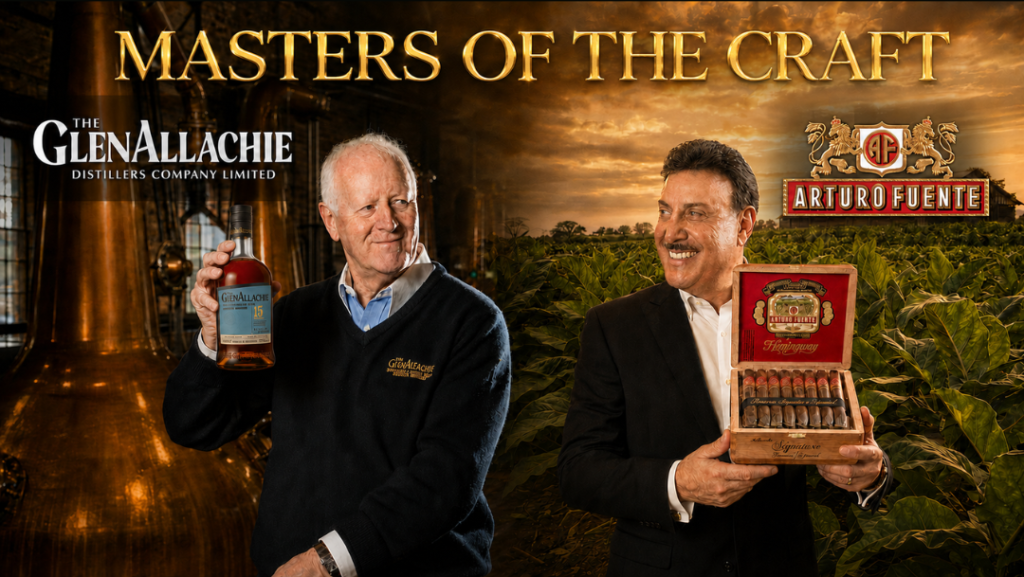
The answer, I decided, had to come from another company whose name carries the weight of experience. It had to be a cigar from a family that has spent generations learning its craft. For me, there could be only one: Arturo Fuente, the company whose cigars I smoked almost exclusively when I cut my teeth during the cigar boom of the early 1990s. More specifically, it would be the Figurado Signature from the Hemingway series.
One side represents a lifetime devoted to mastering whisky.
The other represents generations devoted to masting cigars.
A Lifetime in Whisky
Billy Walker’s whisky career began in 1972 at Hiram Walker & Sons. More than five decades later, his fingerprints can be found across some of the most celebrated revival stories in modern Scotch whisky. His work at BenRiach, GlenDronach and Glenglassaugh helped return neglected names to prominence, but GlenAllachie may be the clearest expression of everything he learned along the way.
Walker and his business partners acquired GlenAllachie in 2017. Until then, the distillery’s whisky had largely lived in the background as a component for blends. Under the new ownership, GlenAllachie stepped into the light as a single-malt brand, with its first core range arriving in 2018.
What makes Walker compelling is not simply the number of years on his résumé. Longevity alone does not make a master. It is what he has done with those years: combining the discipline of a chemist with the instincts of someone who has spent a lifetime nosing spirit, following casks, and learning when whisky has reached its sweet point.
That is why the 15-year-old matters here. It is not the oldest, rarest, or most expensive whisky GlenAllachie offers. It does not need to be. To my palate, it is the expression in the regular lineup that most clearly captures Walker’s house style. It is rich without becoming clumsy, sherry-forward without losing the whisky beneath the wood, and serious without becoming inaccessible.
The whisky is bottled at 46 percent ABV, without added color and without chill filtration. Pedro Ximénez and Oloroso sherry casks bring the dark-fruit richness that defines it. In the glass, I found deep copper color, dark red fruit, currants, raisins, nuttiness, and a touch of breadiness—almost like an American biscuit. The finish carried on for at least a minute, with enough warmth to remind me that 46 percent matters.
But those details are not the real point. The point is that the whisky tastes assured. It tastes like someone knew exactly what he wanted it to become.
Generations in Cigars
Arturo Fuente represents a different kind of mastery. Billy Walker’s side of this story is the accumulation of knowledge across one remarkable career. Fuente’s is knowledge carried through a family.
Arturo Fuente founded A. Fuente & Company in West Tampa in 1912. What followed was not a smooth march toward success. The family endured a devastating factory fire, long interruptions, political upheaval, lost facilities, and repeated reinvention. Yet the company survived, rebuilt, and continued. Four generations later, Arturo Fuente remains family-owned and operated, and its name has become one of the standards by which premium cigars are judged.
That history is precisely why I chose the Hemingway Signature. The Hemingway line is more than a familiar cigar wearing a famous name. Its Perfecto shape represents a difficult, old-world style of rolling that had nearly disappeared. Carlito Fuente has explained that making a true Perfecto requires a real master, and that reviving the shape was a way to keep the art, tradition, and craft alive.
In other words, the shape itself carries the thesis of this article.
The Signature is a six-inch Figurado with a Cameroon wrapper over Dominican binder and filler. It is not Fuente’s rarest cigar. It is not an OpusX, nor is it intended to compete with the limited-production trophies that command attention precisely because they are difficult to find. The Hemingway Signature is something more useful for this comparison: a premium cigar with a deeply recognizable identity that can still be found on the shelf and enjoyed without ceremony. I paid $10.75 per cigar.
I knew its character before I lit it: that sweet, old-school aroma of leather, cocoa, and spice that takes me back to the cigars that started me on this road more than three decades ago. The cold draw added citrus and a raisin-like sweetness. Once lit, the cigar produced generous smoke and delivered leather, cocoa, pepper, and allspice through a mild-to-medium body.
It was not a cigar that changed costumes every inch. It did something more fitting for a story about Fuente.
It remained itself.
Consistency is the word.
The Products as Proof
That phrase came to me during my second evening with the pairing: consistency is the word. The burn remained close to perfectly round. The ash held firm and came away in solid sections. The draw required just enough effort to remind me that the cigar was properly filled, never loose or airy. The flavors held steady through the final third, changing only when I smoked it almost to the last knuckle and simple combustion heat finally took over.
Some readers may hear ‘consistent’ and assume I mean uncomplicated. That would miss the point. Complexity can be thrilling, but consistency is one of the hardest achievements in any product made from agricultural materials and shaped by human hands. Fuente has earned its reputation not because every cigar offers a new surprise, but because smokers know what the name promises.
The same principle applies to the GlenAllachie 15. I called it ‘quintessential Billy Walker’ during the first tasting, and I meant it. The whisky does not require a biography lesson to make its case. Walker’s experience is already there in the glass—in the balance between spirit and wood, in the concentration of fruit and spice, and in the confidence of the final result.
That is where this comparison became more than a convenient match between a whisky and a cigar. These are two different forms of accumulated knowledge. One is the work of a man who has spent more than 50 years learning whisky. The other is the work of a family that has spent more than a century preserving, teaching, and refining the craft of premium cigars.
And What of the Pairing?
The pairing itself was very good, although not perfectly equal—and honesty requires saying so.
On the first evening, the Hemingway began with a somewhat restricted, concentrated opening. As the burn reached the full dimension of the Figurado, the cigar opened, and the pairing improved considerably. On the second evening, another Signature behaved beautifully from the first light. That difference was a useful reminder not to turn one cigar’s behavior into a universal rule.
Across both sessions, the larger pattern was clear. The GlenAllachie was the more powerful partner, while the mild-to-medium Hemingway played the supporting role. The cigar amplified the whisky’s red fruit and brought forward a little more pepper. The whisky did not noticeably improve the cigar—but importantly, it did not diminish it either. They did not fight, and neither lost its identity.
This was an enhancement pairing rather than a perfectly reciprocal one. The Hemingway helped the GlenAllachie more than the GlenAllachie helped the Hemingway. I do not consider that a failure. Quite the opposite: the cigar understood its role, if you will, and performed it with the same quiet consistency that has kept Fuente in humidors for generations.
The whisky remained unmistakably Billy Walker. The cigar remained unmistakably Fuente. Together, they created enough harmony to make the experience better while allowing each product to tell its own story.
Masters of the Craft
It would be easy to write this as another list of aromas, flavors, strengths, and finishes. Those things matter, but they are not why this pairing stayed with me.
The real story is what came before the pour and before the light.
It is Billy Walker beginning his career in 1972, studying the building blocks of whisky and spending the next five decades learning when science must yield to judgment. It is Arturo Fuente beginning in West Tampa in 1912, a family losing factories, rebuilding, moving, teaching the next generation, and refusing to hurry the work. It is a difficult Perfecto shape kept alive because tradition is worth preserving. It is a distillery once known primarily for blending stock, becoming a single malt with a distinct voice.
The GlenAllachie 15 and Hemingway Signature are important because they make those histories tangible. They allow us to taste the result of time—not time as a number on a label or a date in a company timeline, but time converted into instinct, standards, and identity.
I have admired Arturo Fuente since the early 1990s, and my walk through GlenAllachie with Billy Walker gave me a personal view of the other side of this pairing. After spending two evenings with the whisky and cigar together, I came away thinking that I will probably continue drinking one and smoking the other for the rest of my life.
That may be the highest compliment I can give either of them.
Mastery does not always announce itself with spectacle. Sometimes it simply tastes exactly as it should.

